Dr. Nejat Tamzok
Not: This article was published on the Eurasia Review on July 20, 2026: https://www.eurasiareview.com/20072026-baghdads-search-for-an-oil-outlet-the-iraq-turkiye-pipeline-deadlock-the-kirkuk-baniyas-card-and-the-development-road-analysis/
The Strait of Hormuz, the transit route for nearly 30% of the world’s oil trade, is widely considered one of the most critical linchpins of global energy security. With the outbreak of war involving the US, Israel, and Iran, traffic through this vital waterway has ground to a near-halt. This severe disruption has not only accelerated the search for alternative supply routes across the Middle East but has also intensely sharpened the strategic competition among global and regional powers.
One of the most dynamic and ambitious actors on this geopolitical chessboard is undoubtedly Türkiye. Ankara has recently been making critical moves to capitalize on its unique geographic position between East and West, aiming to solidify its status as a premier energy and logistics hub.
The Development Road Vision and Türkiye’s Route Strategy
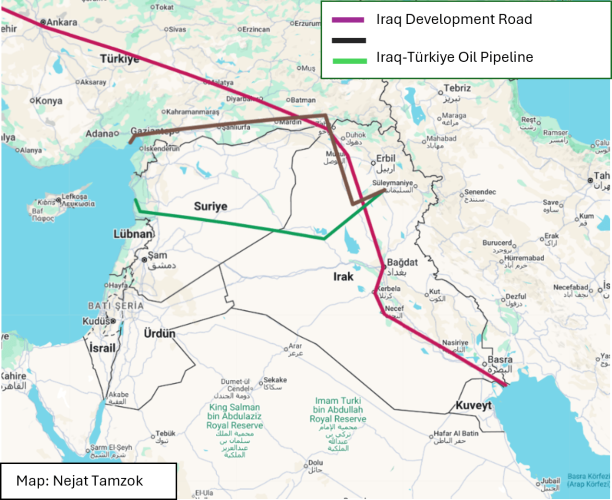
Foremost among Ankara’s comprehensive initiatives in this domain are its extensive diplomatic efforts on the Development Road Project, widely regarded as one of the largest infrastructure undertakings in Iraqi history. Designed to connect Iraq’s Al-Faw Port on the Persian Gulf to Europe via an intricate network of railways and highways, this mega-project is envisioned not only as a strategic energy corridor for transporting Gulf oil and natural gas but also as an intercontinental logistics route and a digital data highway.
Advanced to its current stage through Türkiye’s active diplomatic engagement, a four-party Memorandum of Understanding (MoU) has already been signed between Türkiye, Iraq, Qatar, and the United Arab Emirates. However, while Türkiye’s initiatives to integrate the route into European markets via Anatolia continue, uncertainties regarding the project’s final alignment have not yet been fully resolved.
Two recent critical developments have further complicated the equation surrounding the future of the Development Road: The first is the deadlock in the renewal process of the 53-year-old Iraq-Türkiye Crude Oil Pipeline (ITP) Agreement; the second involves the groundbreaking statements made by US President Donald Trump following high-level contacts between Washington and Baghdad.
The Iraq-Türkiye Pipeline and Legal Impediments
The Iraq-Türkiye Crude Oil Pipeline—popularly known as the Kirkuk-Yumurtalik Pipeline—was constructed under a 1973 agreement between Ankara and Baghdad to transport crude oil from Kirkuk and other regional fields to the Adana-Ceyhan Terminal on the Mediterranean. Ankara has long advocated for extending this pipeline southward to Basra, thereby offering Iraqi oil a direct gateway to global markets and mitigating global reliance on the Strait of Hormuz.
Nevertheless, this conduit faces both technical and legal impediments. The pipeline’s nominal transit capacity of approximately 1.5 to 1.6 million barrels per day, crossing Türkiye’s Southeastern Anatolia region, remains modest when contrasted with the massive daily volume of 20 to 22 million barrels that flows through Hormuz. Furthermore, the pipeline has never operated at full capacity since its inception—historically averaging only 25% to 30% utilization—and has long been the subject of chronic litigation between the two nations.
The root of the dispute lies in the period between 2014 and 2018, when the Kurdistan Regional Government (KRG) exported independently produced oil via Ceyhan without the approval of the central government in Baghdad. Invoking the 1973 Agreement, which dictates that oil exports can only be executed under the instruction of the state-owned marketer SOMO, Baghdad initiated international arbitration against Türkiye. In 2023, the Paris-based International Chamber of Commerce (ICC) Court of Arbitration concluded the case, ordering Türkiye to pay a net compensation of $1.471 billion. This award became legally binding following the Paris Court of Appeal’s recent rejection of Türkiye’s annulment bid.
Rejecting the compensation payment, Türkiye subsequently declared that it would not renew the agreement past its official expiration date of July 27, 2026, leading to the closure of the valves. Although oil flows resumed following a temporary compromise reached in September 2025, the prolonged stagnation of over two years inflicted billions of dollars in lost revenue on both Baghdad and the KRG. Compounding the issue, a second arbitration file covering the post-2018 period is still on the table.
Ankara’s Bargaining Chip: Integrating the Development Road

As the agreement nears its final hour, Ankara has introduced a strategic prerequisite in the ongoing renewal negotiations: the complete integration of the pipeline with the Development Road Project spanning from the Persian Gulf to Türkiye. Ankara proposes that the corridor should not be confined to northern Kirkuk crude but should extend down to the lucrative southern fields of Basra, incorporate other Gulf states into the system, and run parallel oil and gas pipelines alongside the rail and road networks to forge a comprehensive regional energy corridor. In contrast, rather than binding itself to long-term structural commitments, the Baghdad administration appears inclined to buy time by seeking a straightforward one-year extension of the current framework.
While Türkiye has taken substantial and concrete steps toward the Development Road, shifting regional dynamics appear to have decelerated its momentum. Indeed, as Turkish Foreign Minister Hakan Fidan recently remarked, although regional countries initially approached the project with immense enthusiasm, “they later stepped on the brakes when it came to moving the matter forward.” Baghdad’s hesitant posture in the pipeline negotiations directly underscores this observation.
Iraq’s Syrian Card and the Washington Influence
Yet, as bargaining persists between Ankara and Baghdad, a game-changing move has emerged from the Iraq-Damascus-Washington axis. According to regional sources, the US, Iraq, and Syria are planning to reactivate the historic 800-kilometer Kirkuk-Baniyas Pipeline—despite its immense geopolitical risks—to break Iran’s chokehold over Hormuz and establish an alternative Mediterranean outlet for Iraqi crude. Under this scheme, a new pipeline boasting a capacity of 2 million barrels per day will be built to replace the defunct legacy infrastructure, tracing a strategic Kirkuk–Al-Tanf–Homs route to reach the ports of Baniyas and Tartus. Furthermore, ahead of Iraqi Prime Minister Ali al-Zaidi’s high-profile visit to Washington, the Iraqi government officially declared that alternative export routes are actively on the table to mitigate the potential fallout of a prolonged blockade at the Strait of Hormuz.
In Washington, following a pivotal meeting at the White House between US President Donald Trump and Prime Minister Ali al-Zaidi, Trump signaled a potential redrawing of regional transit routes by announcing that “a large number of major new oil deals” with Iraq are underway. Simultaneously, the US State Department confirmed its official endorsement of pipeline initiatives designed to channel Iraqi crude directly to Syria’s port of Baniyas.
Ultimately, the Kirkuk-Baniyas Pipeline serves as a potent geopolitical indicator far transcending mere infrastructure. If successful, it possesses the leverage to alter regional corridor blueprints and profoundly reshape the balance of power in the Middle East.
The Fragile Geographies of Corridors and the Shadow of IMEC
At this juncture, whether the Development Road Project will ultimately interface with global markets via Türkiye, Syria, or an entirely different trajectory remains highly uncertain. The backdrop to this dilemma is an overarching global war of corridors: as the Development Road emerged as a formidable counter-weight to the US-backed India-Middle East-Europe Economic Corridor (IMEC)—which is Israel-focused and currently stands operationally frozen due to ongoing hostilities—it became impossible for Washington to remain a passive bystander.
Prior to the crisis, Baghdad exported the lion’s share of its oil production via the southern Persian Gulf; yet the closure of Hormuz has forced it to pivot its gaze northward. For an administration whose state budget relies on oil revenues for roughly 90% of its funding, securing a northern or western exit is no longer an alternative—it is an existential imperative. Consequently, Iraq’s quest for robust partnerships along this path is entirely rational. However, in a Middle Eastern geography where cyclical alliances are swiftly formed and dissolved, predicting the exact points through which energy corridors drawn on paper will actually pass remains, as always, highly elusive.
Ankara, July 2026, enerjipolitik.com