by Dr. Nejat Tamzok
Original source: https://www.eurasiareview.com/26062026-the-great-mineral-realignment-the-g7s-supply-chain-alliance-and-turkeys-strategic-crossroads-analysis
The Middle East geography constitutes one of the primary logistical backbones of global trade. Situated at the crossroads of Asia, Europe, and Africa, this ancient region plays host to the world’s three most critical maritime passages: the Suez Canal, Bab-el-Mandeb, and the Strait of Hormuz. Connecting Asia’s massive manufacturing power to Western consumer markets, and Africa’s raw material resources to Eastern production hubs, the region stands as the epicenter of global hegemony struggles and corridor wars.
Beyond its strategic location, the region is the nerve center of energy resources—the lifeblood of the global economy. It holds half of the world’s proven oil reserves and approximately 40 percent of its natural gas deposits, accounting for 30 percent of the global crude oil supply and nearly 20 percent of the global natural gas supply. Moreover, it is no longer just a production center for traditional fossil fuels; with green hydrogen projects, mega solar energy investments, and cross-continental electricity grid integrations, it stands out as one of the most dynamic power hubs directly shaping the future global energy architecture. Consequently, the security and control of this region, as has been the case throughout history, corresponds directly to a struggle for global dominance rather than mere commercial competition.
The Washington–Tel Aviv Axis: IMEC and the Strategy to Encircle China
One of the most concrete steps in this struggle was taken in September 2023 at the G20 Summit in New Delhi. The Memorandum of Understanding on the India-Middle East-Europe Economic Corridor (IMEC)—signed by the US, France, Germany, Italy, Saudi Arabia, India, the UAE, and the EU—triggered a new fault line in global geopolitics.
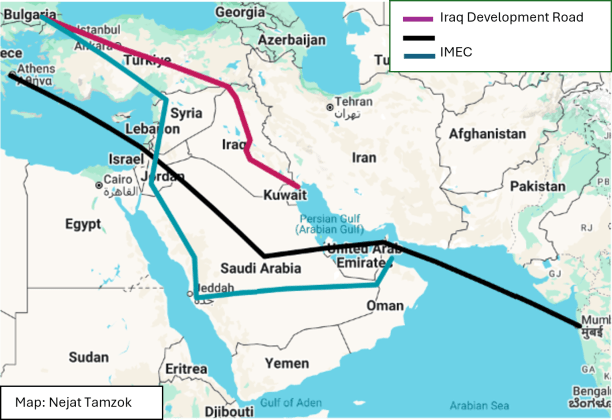
The Washington-backed IMEC route was envisioned to stretch across India, the UAE, Saudi Arabia, and Jordan to Israel’s Port of Haifa, and from there by sea to Europe. Two major strategic objectives underpinned the project: preventing Gulf capital and energy from shifting toward the China/BRICS axis, and forging a potent alternative to Beijing’s Belt and Road Initiative (BRI).
The “No Corridor Without Turkey” Proclamation and the Development Road
While this route—which bypasses the Strait of Hormuz and claimed to bring historical adversaries like Saudi Arabia and Israel to the same geoeconomic table—was being drawn, the region’s most deeply rooted actors—Turkey, Iran, and Egypt—were left outside the equation.
At the time, the clearest and sharpest reaction to this plan came not from China or Russia, but directly from Ankara. President Erdoğan’s declaration that “there can be no corridor without Turkey” was, in fact, the proclamation of a geographical reality. Against IMEC’s Israel-centered Mediterranean outlet, Ankara put its own strategic card on the table: the 17-billion-dollar Development Road Project. To this end, a multilateral agreement was signed between Turkey, Iraq, Qatar, and the UAE. Designed as Iraq’s largest historical infrastructure gambit, this route aims to connect the Grand Port of Al-Faw to Europe via a 1,200-kilometer railway and highway network running through Iraq and Turkey. It seeks to reduce dependence on the Strait of Hormuz and the Suez Canal, cutting transit times between Shanghai and Rotterdam from 33 days to 15 days. The project is conceived not merely as a logistics route, but as a strategic energy corridor for transporting Gulf oil, natural gas—and potentially green hydrogen—to Europe, alongside a digital data highway.
The Return of History: The Modern Hejaz Railway

While the crisis that erupted in Gaza on October 7, 2023, effectively froze IMEC’s political foundation based on Israeli-Arab normalization, Ankara took another step in corridor diplomacy by bringing the Hejaz Railway to the agenda—right in the midst of ongoing diplomatic maneuvers between the US and Iran.
The recent agreement signed between Turkey and Saudi Arabia in Riyadh aims to revitalize the Hejaz Railway, the Ottoman Empire’s final grand yet tragic vision, within the modern global order. The vision announced by Minister of Transport Uraloğlu is ambitious: a line connecting from Turkey to Aleppo will extend through the existing Aleppo-Damascus-Jordan route to Riyadh, and ultimately to Oman—reaching the open ocean. Though a cautious diplomatic language is preferred, the resonance this step creates in historical memory is profound. The project reflects Ankara’s aspiration to position Turkey at the absolute center of regional transit between Europe, the Levant, and the Persian Gulf.
Technically, it is impossible for railway lines to fully substitute for the massive oil trade flowing from the Persian Gulf to Asia, or for train wagons to shoulder the millions of barrels carried by supertankers. Therefore, the thesis that this project will “completely render Hormuz obsolete” could be considered an exaggeration. However, it is highly probable that this line will play a critical role as a “strategic backup route” during energy crises or periods of hot conflict.
The primary geostrategic objective here appears to be introducing another robust alternative—alongside the Development Road—to the IMEC project, which frames Israel as the central hub connecting the Gulf to Europe, thereby balancing Israel’s regional influence. At this juncture, while IMEC elevates an Israel-based gateway, it is worth re-emphasizing that for both the Hejaz Railway and the Development Road, the gateway to Europe will be Turkey.
Ankara’s Three-Dimensional Corridor Strategy
Through this railway maneuver, Ankara is reinforcing its historical influence in the Levant (Syria-Jordan-Lebanon) while directly balancing the transit role centered on Israel under IMEC. At the current juncture, Turkey has laid out three primary corridor axes before global trade and energy geopolitics:
- The Middle Corridor: The East-West axis connecting China and Central Asia via the Caspian Sea to the Caucasus and Turkey.
- The Development Road: The South-North axis carrying the energy and logistical potential of Iraq and the Gulf vertically to Europe.
- The Modern Hejaz Railway: The Levant-Gulf corridor passing through Syria and Jordan, integrating Turkey into the ocean via Saudi Arabia and Oman.
Throughout world history, trade routes have always determined the winners and losers of global competition. In recent years, the concept of developing new economic and commercial links between countries and continents has gained significant momentum. The idea of living in peace in a world brought closer together by trade routes is undoubtedly very appealing. Yet, in a Middle East where animosities do not expire and structural tensions remain unresolved, it is a well-established reality that such projects carry the potential to kindle rivalry and conflict rather than enhance societal welfare, bringing latent frictions to the surface. At a time when these routes are becoming vital assets for global and regional powers, it is difficult to argue that corridor competition—which essentially amounts to energy warfare—holds no sway over the powder kegs exploding across the Middle East.
In this geography, it has always been easiest to draw a new route on colorful maps; the hardest part is navigating those paths safely to the other side.
Ankara, June 2026, enerjipolitik.com